|
全国2008年10月高等教育自学考试
电子商务英语试题
课程代码:00888
请将答案填在答题纸相应的位置上
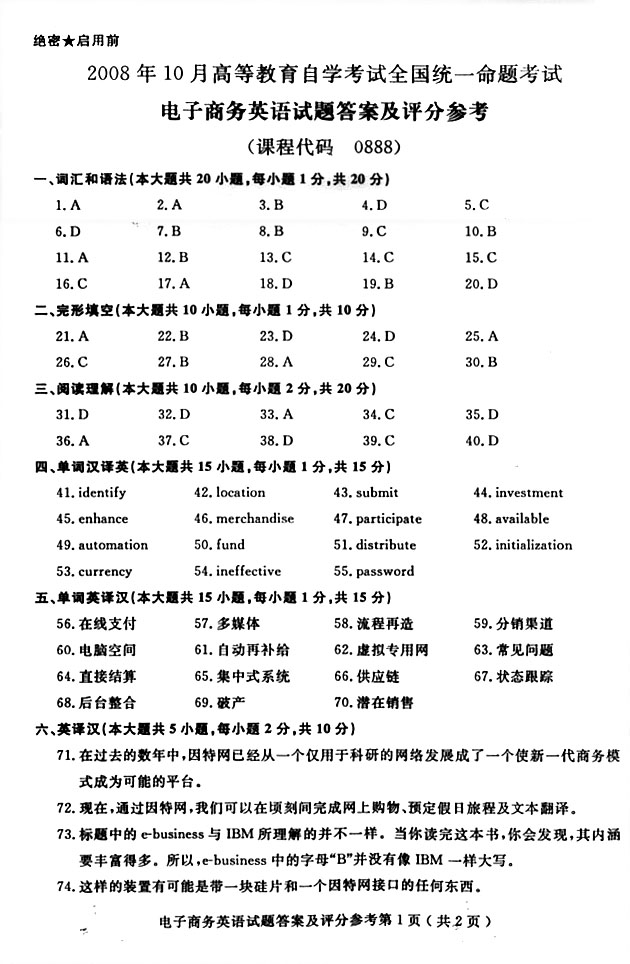
一、词汇和语法(本大题共20小题,每小题1分,共20分)
根据句子的意思选择一个正确的答案,错选、多选或未选均无分。
1. ______under a microscope, a fresh snowflake has a delicate six-pointed shape.
A. Seen B. Sees
C. Seeing D. To see
2. It has been ______ for him by his family to marry a girl of his own class.
A. arranged B. organized
C. settled D. adapted
3. Flight nineteen from New York to Washington is now arriving at ______ .
A. the two gate B. gate two
C. the gate two D. second gate
4. I’d rather listen to ______ than watch ______ .
A. radio television B. a radio a television
C. radio the television D. the radio television
5. All ______ agreed to repeat the experiment.
A. the present people B. the people to be present
C. the people present D. the people having been present
6. There are ______ opportunities for employment in the rural area.
A. less B. little
C. small D. fewer
7. He doesn’t dare to leave the house in case he ______ .
A. is recognized B. will be recognized
C. will recognize D. has been recognized
8. George ______ in this school for forty years by the time he retires.
A. will teach B. will have taught
C. has taught D. will be teaching
9. Weather ______ , we’ll go sightseeing.
A. permitted B. is permitted
C. permitting D. is permitting
10. No one ______ to me like that again.
A. dare to speak B. dare speak
C. dares speak D. dares speaking
11. We ______ tennis in the park when you phoned.
A. must have been playing B. must be playing
C. must play D. must have played
12. Let us have something iced to drink, ______
A. will we B. shall we
C. do we D. don’t we
13. Teachers all ______ the student to enter the competition.
A. cheered B. animated
C. encouraged D. heartened
14. How I wish to ______ in your sufferings.
A. enter B. contribute
C. participate D. provide
15. You should sign a contract to make your job situation ______ .
A. normal B. common
C. regular D. usual
16. A poor memory ______ her efforts to become an actress.
A. encouraged B. accomplished
C. frustrated D. develop
17. Either the shirt or the sweater ______ suitable for this season.
A. is B. are
C. have been D. has
18. All you need to do ______ the form.
A. fill in B. fills in
C. are to fill in D. is to fill in
19. She decided not to ______ her husband’s name when she got married.
A. adore B. adopt
C. admire D. admit
20. I am thinking of ______ a close relationship with my competitors.
A. performing B. settling
C. organizing D. establishing
二、完形填空(本大题共10小题,每小题1分,共10分)
从选择项中选择一个最适合短文的选项,错选、多选或未选均无分。
Several regions in the world are subject 21storms which are so severe that they
22damage on a tremendous scale. The regions are all located on the edges of great oceans. The 23term for such severe storms is ‘cyclone’. The term ‘hurricane’ is 24for storms that occur in the North Atlantic Ocean.
Cyclones(龙卷风) and hurricanes(飓风) differ in one curious 25: in a cyclone, the wind circulates in a clockwise direction; in a hurricane, the wind direction is counter-clockwise.
26cyclones and hurricanes have one ominous similarity. 27the damage they cause on land and at sea, they are identical.
Australia undergoes a number of cyclones every year along its northern coast, which faces Indonesia. The cyclones 28mainly in December and January, the summer months in the southern hemisphere.
Usually the Australian cyclones don’t cause great damage because Australia’s northern territory has vast empty regions that are virtually 29.There are few coastal cities. When a cyclone 30move inland from the sea, it usually blows itself out without striking any inhabited area.
21. A. to B. for C. of D. on
22. A. make B. cause C. happen D. suffer
23. A. full B. common C. ordinary D. general
24. A. made B. called C. meant D. defined
25. A. way B. manner C. angle D. feature
26. A. However B. And C. But D. Then
27. A. In that B. In terms of C. Except for D. Along with
28. A. occur B. rise C. raise D. foster
29. A. populated B. deserted C. unpopulated D. undeserved
30. A. could B. does C. would D. should
三、阅读理解(本大题共10小题,每小题2分,共20分)
阅读下面的短文,从A、B、C、D四个选项中选出一个最佳答案填空或答题,错选、多选或未选均无分。
Passage 1
Personal interviewing (面试) is most effective when all the people to be interviewed are located in a relatively small geographical area. Otherwise, the time and expense spent in traveling from one person to another makes this type of interviewing economically impractical. Personal interviewing is usually used when the information needed is too complex to be gathered by another technique. For example, a problem being studied may require the interviewer to probe beyond the more superficial answers that might be obtained with another method.
It is sometimes assumed that personal interviewing is the most accurate of all survey research techniques. Although personal interviewing may be accurate in many cases, human errors may prevent a researcher from obtaining valid results. Questions perceived by the interviewee (应试者) as an invasion of privacy or threatening in any way will probably produce false or partially true answers. Also, since the interviewer (面试者) must interpret the respondent’s statements, a certain amount of information loss results even though the respondent may be answering truthfully.
In spite of the problems, at least two major advantages are provided by this research technique. First, the alert interviewer can generally tell if the respondent is being truthful or if he or she is giving superficial or untrue responses. Second, the interviewer can rephrase questions, give more explanation, or probe more deeply if the initial questions do not produce the information desired. As a result, the information gleaned should be more accurate than that provided by interviews where no one is present to clarify questions or to interpret answers.
31. Sometimes a researcher cannot get valid results because ______.
A. the information needed is too complex to be gathered
B. personal interviewing is the most accurate of all survey research techniques
C. personal interviewing is not as effective as other research techniques
D. both interviewer and interviewee may make mistakes during the interviewing
32. In the first sentence of the last paragraph, the pronoun “this” refers to ______.
A. survey B. question
C. answering D. personal interviewing
33. According to the last paragraph, one of the advantages of the personal interviewing is ______.
A. the interviewer can ask the interviewee questions again in different ways
B. the interviewer can ask the interviewee some personal questions
C. the initial question do not produce the information desired
D. no one is present to clarify questions
Passage 2
In the United States, boys and girls start school when they are five years old. In some states they must stay in school until they are sixteen. Most students are seventeen or eighteen years old when they graduate from secondary school. Another name for secondary school is high school.
Most children go to public elementary and secondary schools. The parents of public school pupils do not have to pay directly for their children’s education because tax money supports the public schools. If a child attends a private school, his parents pay the school for the child’s education.
Today about half of the high school graduates go on to colleges and universities. Some colleges and universities receive tax money from the government. A student at a state university does not have to pay very much if his parents live in that state. Private colleges and universities are expensive; however, almost half of the college students in the United States work while they are studying. When a student’s family is not rich, he has to earn money for part of his college expenses.
34. The students in all the states of the U. S. must finish ______ school until they are ______ at least.
A. high eighteen B. elementary seventeen
C. secondary sixteen D. starting five years old
35. In America the parents whose children go to public schools ______ for their children’s education, while the parents whose children attend private schools ______.
A. do not pay any will pay much money
B. pay no pay much
C. pay directly don’ t have to pay directly
D. don’ t pay money directly must pay plenty of money
36. About 50 per cent of the university students in the United States ______ to get ______ their college education.
A. work while studying some money for
B. must work hard all night earning much money for
C. work at night while study in the day some money for
D. works while studying part of the money for
Passage 3
Searching by keyword is the most common method of using a search engine, but the problem with keywords is the relatively imprecise results and the return of a lot of irrelevant information. Keywords may have more than one meaning and search results may be found only by using a synonym of the keyword. The method of browsing on the other hand takes too much to find the relevant information. Directories like Yahoo try to circumvent the problem, but the manual process of classifying material on the web takes up too much time, resulting in very few search results, as not everything on the web can be classified. Therefore new paradigms of searching are needed as well as new software that is able to categorize web sites automatically.
The majority of search engines come from the United States and has specialized in English resources and information reflecting the American culture. People who do not speak English or who are non-native speakers have therefore many disadvantages on the web.
The centralized approach to information retrieval has extreme difficulty in coping with the multilingual and multi-cultural nature of the information society. The Internet has become a success throughout the world, but the American search engines operate with a US-centric company structure and tend to concentrate upon the English language. Although many search engines have subsidiaries in many other countries, like Japan or Italy, the way the information is presented is the American way and may not reflect the logic of the people who are using it.
National search engines in Russia or France, for example, have to deal with far smaller sets of information and specialize in the cultural and linguistic environments that they know best. Their disadvantage is that the queries are in Russian or French and the search results contain only a small subset of possible results on the web, as they are restricted to the language. This strongly reduces the possibility of using the Web as a source for the worldwide diffusion of information.
Larger search engines, such as Altavista are able to perform multilingual searches, which presents search results in multiple languages. This is good, if the searcher knows all the languages, but if, for example, an Indian finds a Japanese web site on the search topic, this may not be helpful.
Text documents that are in special formats (such as Postscript or Star Office Documents) are unreachable for many search engines, as the textual information is embedded into the binary structure of the particular file format. The same applies to scanned documents, Java applets and video/audio clips. The content of these file formats is hidden from search engines today. Only if the description of the file format is known and included into the search engine is it possible to add the content for certain document types. This is relatively easy, just a matter of work. Infoseek for example, is able to index the content of Word documents. More difficult is the inclusion of content that is hidden in applications, as there is no way to tell where the information may be hidden.
The research and development in information and data retrieval is aimed at improving the effectiveness and efficiency of retrieval. Individual and parallel development for database management systems has left this sector without a centralized vision and coordination between the different types of search engines. Search engines on the Internet are very specific and not able to cope with multiple database formats and file types. In order to make searches complete a search engine needs to search over text, documents, images, sounds and all other media formats. So the database integration will be the single most important objective for the future of intelligent search engines.
37. The problem with searching by keywords is ______.
A. although the results are more precise the information is abundant
B. although the results are not precise the information is not enough
C. the results are not precise and the information is more than necessary
D. none of the above
38. Which of the following is true about the search engines from the U.S.
A. All of them specialized in English resources and information.
B. They operate with a US-centric company structure and tend to concentrate on various languages.
C. They provide only cultural resources and information.
D. It is not convenient for non-English speakers to use.
39. It can be learnt that if an Italian uses American search engines subsidiaries in Italy he may have the problem of ______.
A. not being able to find the information that he needs
B. not knowing how to use the search engines
C. having to try to understand the American logic first
D. having to learn English first
40. Search engines cannot work very efficiently today because ______.
A. there is no coordination between the different types of search engines
B. search engines on the Internet are very specific and not able to cope with multiple database formats and file types
C. search engines need to search over different categories to make searches complete
D. All of the above
四、单词汉译英(本大题共15小题,每小题1分,共15分)
根据给出的汉语词义和规定的词类写出相应的英语单词。该词的第一个字母已经给出。
41.确认,鉴别 v. i_________
42.地方,位置 n. l_________
43.服从,顺从,提交 v. s_________
44.投资 n. i_________
45.增强 v. e_________
46.商品,货物 n. m_________
47.参与,参加 v. p_________
48.可用的,可获得的 adj. a_________
49.自动化,自动 n. a_________
50.基金,经费 n. f_________
51.分配,分发,分布 v. d_________
52.预置,初始化 n. i_________
53.流行,货币 n. c_________
54.无效果的 adj. i_________
55.口令,密码 n. p_________
五、单词英译汉 (本大题共15小题,每小题1分,共15分)
给出下列单词或术语的汉语意义。
56.on-line payment
57.multi-media
58.business process re-engineering (BPR)
59.distribution channel
60.cyberspace
61.automatic replenishment
62.virtual private network (VPN)
63.frequently asked questions (FAQ)
64.direct billing
65.centralized system
66.supply chains
67.status tracking
68.back-end integration
69.out of business
70.potential sales
六、英译汉 (本大题共5小题,每小题2分,共10分)
阅读下面的短文,然后把划线的句子翻译成汉语。
(71)Over the last few years the Internet has evolved from being a scientific network only, to a platform that is enabling a new generation of businesses. The first wave of electronic business was fundamentally the exchange of information.
But, with time, more and more types of businesses have become available electronically. (72)Nowadays we can buy goods online, book holidays or have texts translated over the Internet in an instant. Home banking, for example, is one application that is already provided by most banks around the world. Looking up your balance, transferring money and other transactions are done every day by millions of people. Public administration has discovered the Internet as a means to talk to the general public at election times. And it will not be a long time before we see general elections decided on the Internet.
The reason why I have called this book “The E-business (R) evolution” is that the approach is twofold. Technology has revolutionized the way we can do business. But business itself is only slowly adapting to the new possibilities. The New Economy needs a new paradigm, but the process of conversion will take some time to complete. The necessary technology is ready and wailing. (73)the e-business in the title is not the same as IBM is seeing it, it is much more, as you will discover by reading this book, therefore the “B” in e-business not written in capital letters as in IBM’s ease.
The Internet is changing the concept of programming applications. We are moving towards pervasive computing and towards electronic services. The Jini technology is one of the first implementations of what one could call “one world, one computer.” Jini allows every device to talk to every other device in a common language. (74)A device in this case can be anything with a silicon chip inside and an Internet connection. Other companies have started to develop similar paradigms, technologies and visions, such as IBM’s T Spaces technology and Hewlett-Packard’s E-Services strategy.
(75)Most probably you already know the example of the empty refrigerator that sends an e-mail to the grocery with a request for fresh milk that will be delivered to the doorstep before breakfast in the morning. Prototypes have already been built. A bar-code reader is able to detect which products are put into the fridge and taken out afterwards. For many people this won’t be a necessity in the future. The grocery is more than just a place where people can buy food. It is a social place where people meet, which cannot be simply replaced by two chips. But for those who do not have the time to do the shopping or are not able to walk lo the grocery, this may become an option.
七、汉译英 (本大题共5小题,每小题2分,共10分)
用括号内给出的词,把下列汉语句子翻译成英语。
76.你可以把不重要的细节删掉。(cut out)
77.她对这消息的反应如何? (reaction)
78.他能确保我们订了房间吗?(make sure)
79.我将负责全公司的协调工作。(coordination)
80.这个公司试图降低产品价格来促进销售。(cut down)

|


